
Find the Business Systems Problems Holding Your Company Back
For founders who know the company is working harder than it should but cannot clearly identify why.
Business systems problems rarely appear as one obvious failure. They show up as missed leads, reports that cannot be trusted, repeated manual work, inconsistent follow-up, disconnected software, weak handoffs, and a founder who still has to hold too much of the business together. We identify where the breakdown is actually happening, separate symptoms from causes, and recommend what should be repaired or built first.

Signs That Business Systems Problems Are Slowing the Company Down
When several of these symptoms appear together, the company usually has a systems problem that has not yet been located—not a motivation problem.
The business is working harder than it should for the results it gets.
Leads come in, but you're not sure where they go or why some vanish.
Your team is busy, yet things still fall through the cracks.
You don't fully trust the numbers you're looking at.
You've added tools, but the problem didn't go away.
You can sense the bottleneck — you just can't point to it.
Lead ownership is unclear after a form, call, referral, or campaign response.
Follow-up depends on individual habits instead of a dependable process.
Pipeline stages do not reflect what is really happening in sales.
Reports require manual cleanup before leadership can use them.
Marketing, sales, and revenue numbers do not agree.
Employees enter the same information into more than one tool.
Customers repeat information because departments do not share context.
Work stalls during onboarding, approvals, or internal handoffs.
The founder is still the default escalation point for routine problems.
Why Business Systems Problems Are Difficult to Locate
As the company grows, the website, CRM, follow-up, sales process, reporting, customer communication, and operations begin depending on each other. A weakness in one area often appears as pain somewhere else.
A website problem may actually be a follow-up problem. A lead-generation problem may be a CRM tracking problem. A sales problem may be weak buyer education. A staffing problem may be an operations workflow problem. A reporting problem may begin with inconsistent data entry.
That is why adding another tool or fixing the most visible symptom often fails. The visible pain and the root cause may exist in different systems. The job is to trace the workflow and data until the real business systems problem becomes clear.
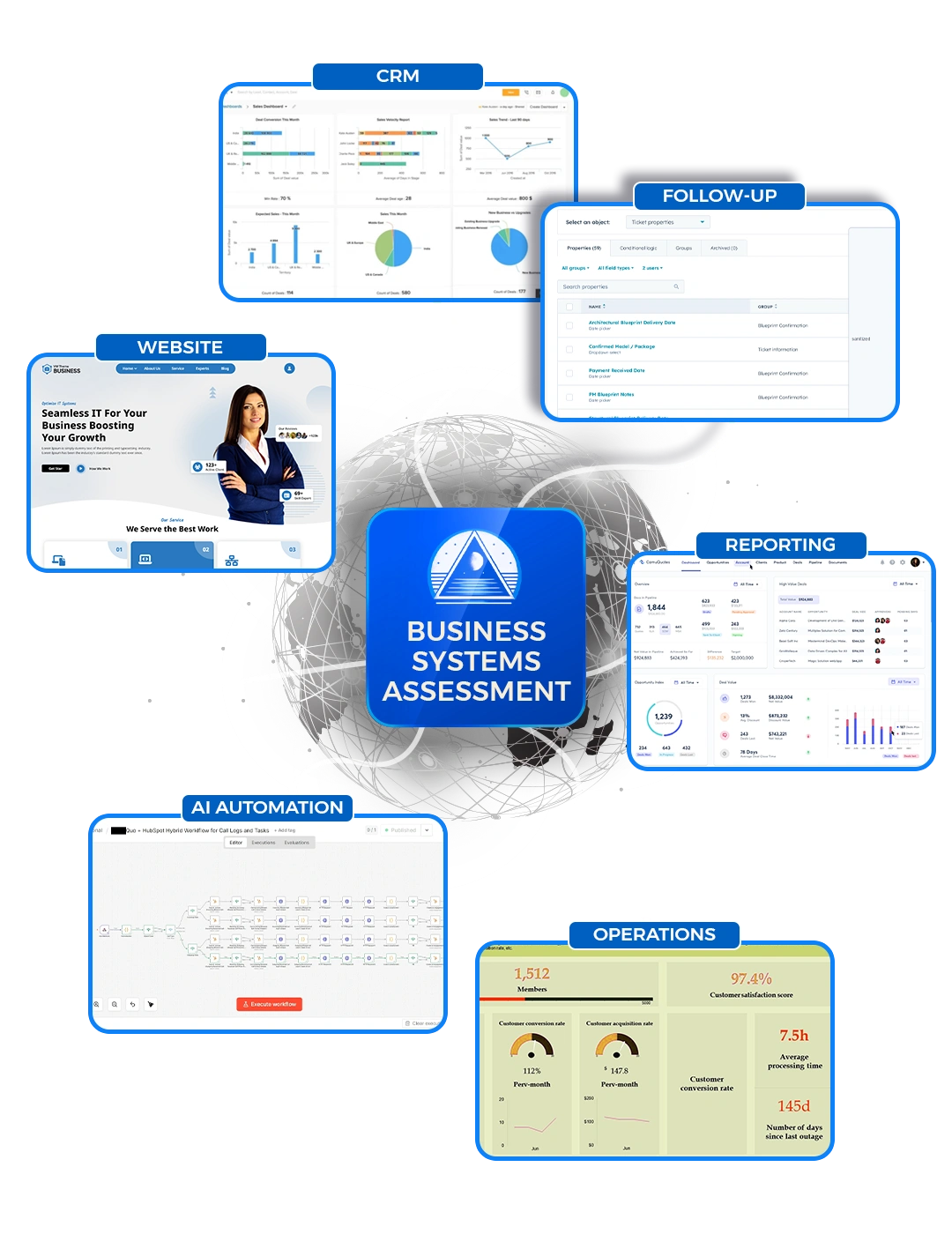
How We Identify Business Systems Problems
A structured path from visible symptoms to a prioritized system-build recommendation.
Where Business Systems Problems Usually Hide
The assessment may reveal one primary problem or several connected issues. Each path below links to the system designed to address that root cause.
From Business Systems Problems to a Clear Build Plan
A clear answer to what's actually holding the business back.
A prioritized plan — what to fix first, what can wait.
The right system built around the real problem, not a guess.
A business that runs with more clarity, control, and momentum.
Your head freed from holding the whole thing together.
Symptoms separated from the underlying causes.
A map of the affected systems, data, ownership, and handoff gaps.
Clear guidance on what should be repaired, replaced, connected, or left alone.
A practical implementation order based on impact and dependency.
Less leadership guesswork and greater control over the next investment.
This Page Is for Founders Experiencing Business System Bottlenecks
This diagnostic path is most useful when the company has enough activity and complexity for weak systems to create measurable cost.
Rapid growth without matching operational clarity.
Increasing lead volume without dependable follow-up.
Multiple tools that do not work together.
Reporting that requires manual interpretation or correction.
Sales activity without predictable pipeline movement.
Too much dependency on individual employees or the founder.
Unclear ownership between sales, administration, and delivery.
Repeated attempts to fix symptoms by adding new software.
Start With a Business Systems Assessment When the Cause Is Unclear
The Business Systems Assessment is for companies that can see the symptoms but cannot confidently determine which system should be fixed first. We review the connected tools and processes behind the problem, identify the most important breakdowns, and provide a prioritized implementation path. This is a paid diagnostic—not a generic discovery call—and the assessment stands on its own.
Business Systems
Problem Questions
Business systems problems are breakdowns in the tools, processes, data, ownership, follow-up, reporting, or handoffs that help the company operate. They often appear as missed opportunities, rework, delays, and unreliable information.
The visible symptom is not always the root cause. We trace how leads, data, activities, communication, and work move across the company before deciding whether the CRM, website, follow-up, reporting, sales process, or operations is responsible.
A new tool cannot solve unclear ownership, inconsistent data, a poorly defined workflow, or disconnected processes by itself. The process and system design must be clear before software can support it.
It is a structured review of how the company’s connected systems work, where information or work breaks down, and which issue should be addressed first.
The assessment may review the CRM, website, lead capture, follow-up, reporting, sales workflow, operational handoffs, automation, AI-supported work, and related tools.
No. The Business Systems Assessment is a paid diagnostic with a defined deliverable: findings, priorities, and a recommended build path.
We identify the dependencies and recommend a phased order. The highest-impact or foundational issue is normally addressed before dependent systems.
No. The assessment stands on its own. You may use the findings internally or proceed with an approved build.
Yes. We retain tools that can support the required system and recommend changes only when the current platform creates meaningful limitations.
Yes. We can review CRM structure, pipelines, fields, workflows, lead ownership, activity tracking, follow-up, integrations, and reporting in HubSpot or GoHighLevel.
We consider financial impact, customer impact, operational risk, frequency, implementation dependency, and whether one issue is creating problems in several other systems.
You receive a prioritized recommendation explaining what should be fixed first, what can wait, and which system build or implementation phase fits the findings.
Yes. Many companies begin with the most foundational build and add connected systems in later phases.
Documentation, testing, handoff, training, and implementation support can be included in the approved project scope.
We explain the limitation and point you toward a more appropriate path rather than recommending a system that will not solve the problem.
The assessment generally starts at $2,500. Larger assessments may range from $3,500 to $5,000 or more depending on the number of systems, workflows, tools, and departments involved.
Stop Guessing About Your Business Systems Problems
When the company is working harder than it should, the first step is identifying the real cause. Start with a paid Business Systems Assessment to receive a prioritized recommendation for what should be fixed first.